Donogrogue Castle
This is private property please do not trespass
You are now passing what’s known as Donogrogue Castle. This was a fortification built by the native Irish at a time when the O’Briens and to a lesser extent the McNamaras were very powerful in Thomond.
Families associated with the castle were:
The McMahons, Hickmans, Ross-Lewins, Maunsells, Rev Edward Langford 1824, Hodges, Taltys and the McInerneys.
It was probably built late in the 15th century, when the other McMahon castles were being erected, but its first reference does not appear until 1574 when it is noted by Edward White that it was owned by Teige McMahon son of Murtagh Cam McMahon. In 1620 the castle of “Doneygrock” was included in the Earl of Thomond’s patent and by 1641 was leased to William Brigdale.
In 1656, during the Cromwellian period, Mr Walter Hickman was placed in the castle, and afterwards obtained a lease of 90 years on the place from the Earl of Thomond on condition that he would supply:
a Protestant horseman with a good horse, a sword, a case of pistols, and other necessities for a month; He also had to plant 100 apple trees, to cover the castle with a roof of slate or shingle, to erect a house one and a half stories 40 ft. by 18 ft. and pay £5.5.10 annually for the lands of Dunagurrog and Kilteilie.
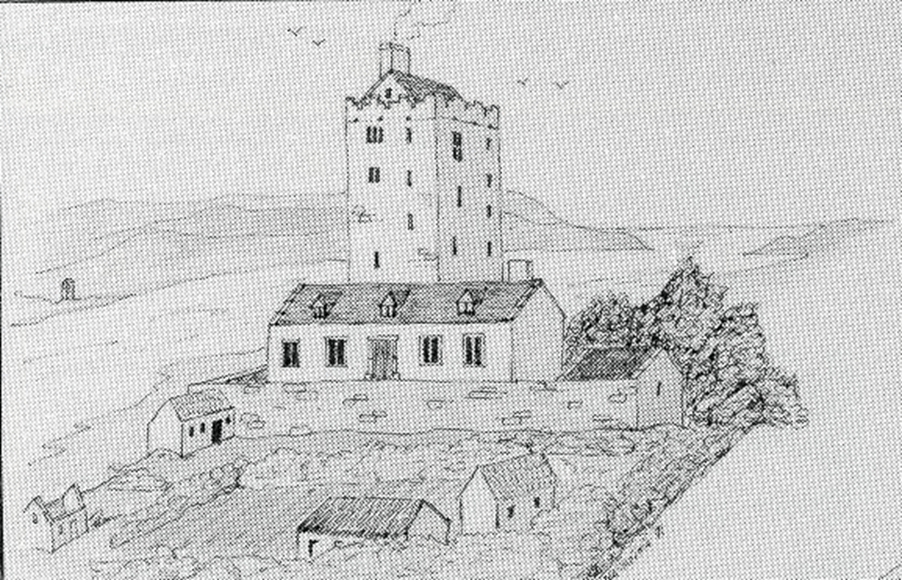
In 1680 Thomas Dineley visited Donogrogue where he made a sketch of the castle and surrounding area and gave the first report of the addition of the house to the castle. In his diary he mentioned “from the hill marked with the letter ‘R’ about 300 paces from the castle is the loudest and plainest echo that I ever heard; it resounds rather louder than the voice or noise you utter.”
In 1799 William Maunsell, owner of the castle, was recorded as being in favour of the Legislative Union of Ireland and Great Britain. In 1824 Rev Edward Langford owned Donogrogue Castle. By 1837 the castle had become the home of George Crowe Hodges whose family had come from the south of England. He was still living there in 1855 and was probably responsible for the large building with its many decorative features that we know today.
The castle became the home of the Roman Catholic curate of Killimer parish, when it was established as a parish. A fee of £100 had to be lodged as a settlement when the curate left the castle to take up duty elsewhere. The leasehold was bought from the Hodges in 1856 by the Talty family from East Clare. Thomas Talty, a member of that family, was a director of the West Clare Railway and a Justice of the Peace in Ireland for the Crown. A verse from the song ‘Knockerra Hill’ reminds us of those glory days:
“I see Tom Talty’s residence The castle of Donogrogue
He was a County Magistrate and worked upon this hill
and when I think of times gone by with tears my eyes do fill.”
Gretta Talty, Thomas Talty’s daughter, married Pat McInerney from Kilferagh. Their son Joe, with his wife Mary Keating from Tullagower, were next to take over the castle and farm. Mary took great pride in the castle and upgraded it over many years. They also successfully ran the dairy enterprise known as the Castle Dairy. Their daughter Anne now resides there.
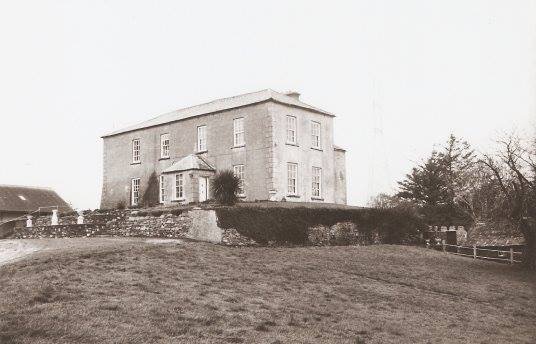
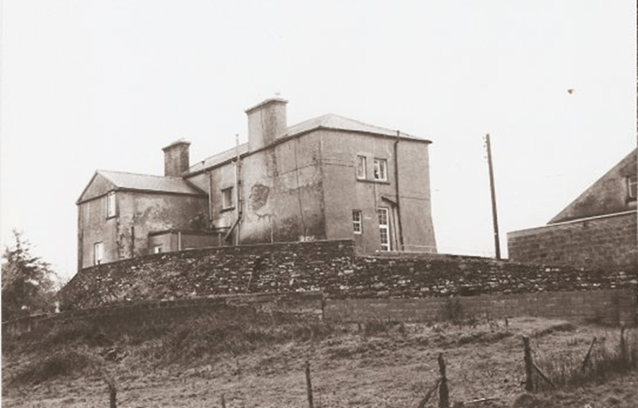
Numerous renovations have been undertaken over the centuries, which have resulted in its present structure. A close inspection reveals that over two thirds of the present house comprise the walls of an old McMahon tower house of the early 16th century. The two-storey house incorporates the ancient castle where the castle section lies to the west. The walls at the base measure four foot in thickness and taper inwards as one looks upwards and a narrow loophole can be seen beside the west door. The whole house is built on an outcrop of limestone rising some fifteen foot above ground level on the north side. This platform is shored by a stone wall of varying heights and parts of this may be of the old barn or courtyard wall shown in Dineley’s sketch of 1680. To the back of the stone building was a dungeon, which has long since been covered over. It seems likely that two or three storeys were taken down in the 18th century and the stone used to complete the present house.
An earthen fort can be clearly seen to the north of the castle and legend has it that a tunnel ran from the castle to Cathair na gCath.
Pecker Dunne
Where you are now also brings you very close to where The Pecker Dunne lived. The famous banjo player Pecker Dunne and his wife Madeline and children settled in Donogrogue in 1990 and proceeded to rear their family and immerse in the local community. He and his family were generous with their talents and performed at many local concerts and in the local churches. His musical heritage is being continued by Stephen – banjo, Tommy – uilleann pipes, Madeline – melodeon, and Sarah – concertina. A testament to his grá for the parish, he made Burrane his final resting place on December 19th 2012.

