Carradotia Evictions
You are in the townland of Carrodotia at the moment and this would have been famous at the time of the evictions that took place here. Eviction in Ireland, under the landlord system, was always a fear the tenants had to live with. There were many instances, at different parts of our history where evictions took place.
Michael Gilligan will give us a short summary of the evictions that happened in our parish around the 1800-1900s.
After the threat of famine had passed, most had thought the were safe from eviction for the time being. However landlords in most parts of the country were evicting large numbers of tenant, largely due to hiking up of their rent, knowing that the land and home owners wouldn’t be able to cope. In the 1880’s the Land League’s “Plan of Campaign” was inaugurated. This was a campaign to put pressure on the landlord, that if he didn’t reduce the rent voluntarily, then his tenants would combine and withhold payments. Kilrush became the national testing ground for this new plan. These evictions would have been different from the famine evictions in that these more commonly were farmers with good solid houses and land. A number of farmers in Killimer would have taken part in this Plan of Campaign against their landlord Hector Stewart Vandeleur. This lead to a number of evictions in 1888.
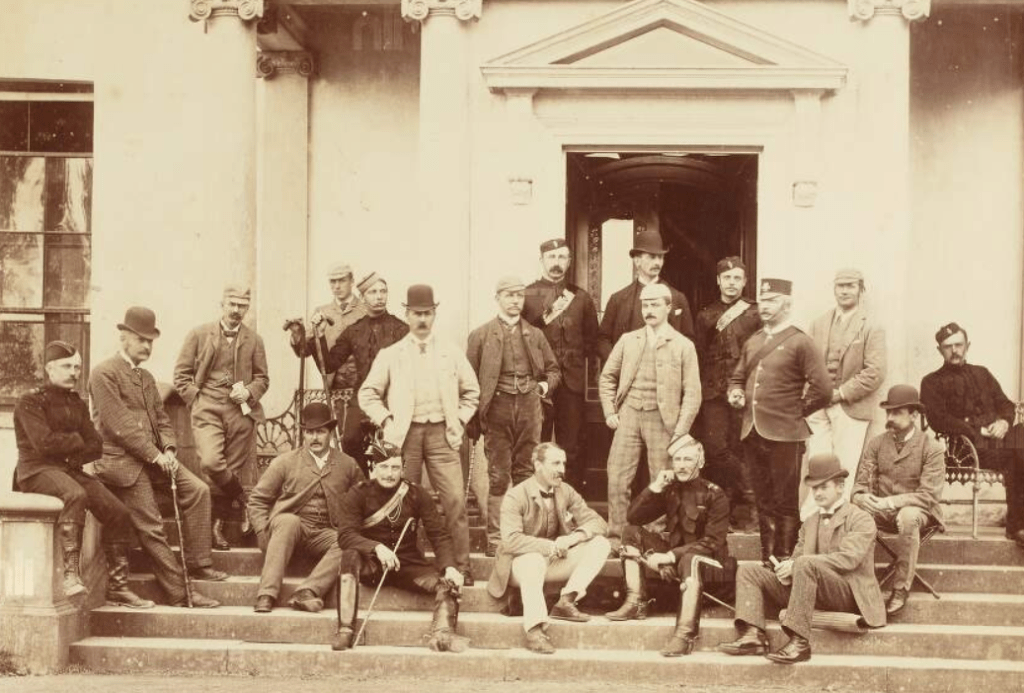
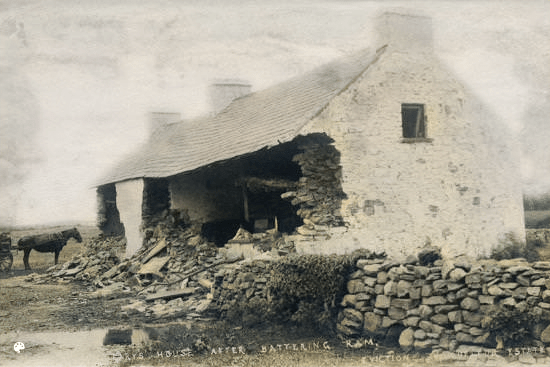
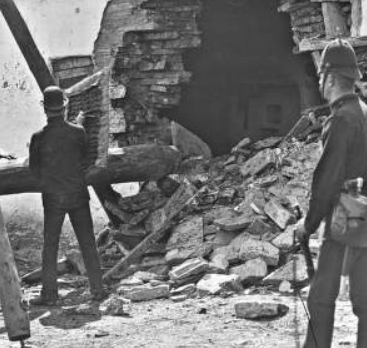
The following evictions in Carradotia were particularly famous not just in Ireland but around the world as a photographer accompanied the eviction force and caught the evictions on camera, this would have been one of the first times photographs accompanied a story and it caught the imagination of many.
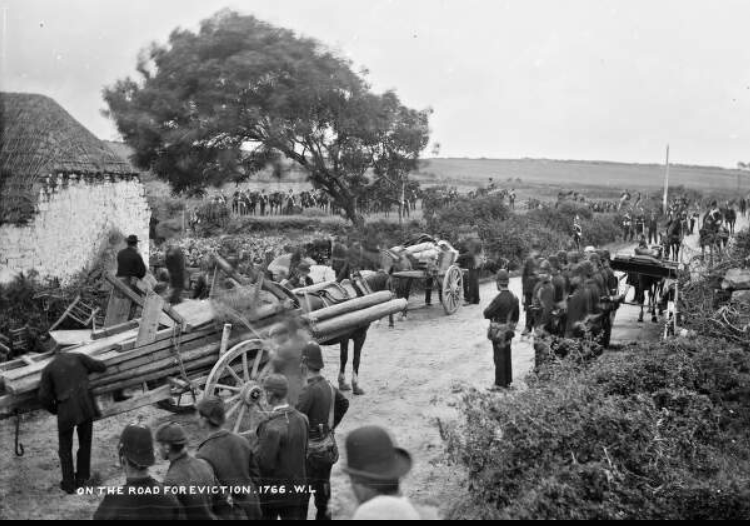
The following is an account of the O’Connell eviction:
On Friday morning, July 3rd, 1888, the eviction force started from Kilrush House to turn out Michael Connell of Carhudotia. ( Mai Crowe’s grandfather). The area of the holding is 40 Irish acres. Valuation £33.15.0, 2.5 years rent due to March 1887, for which he was decreed. The house was barricaded, and the tenant remained outside, calmly smoking his pipe, and inside the house, subsequently to be smashed by the battering ram, he left his little children, girls and boys, some scarcely able to walk.
The roads from Kilrush had been very carefully watched by patrols of police, who walked it all night. The force was very much the same as before, and stretched a distance of nearly 3 miles. Quite near Connell’s house a sudden halt was made. The road was cut up, and a big gullet formed and progress in the ordinary way was out of the question. The Hussars could have jumped it, the infantry no doubt could have scrambled through somehow, but the battering ram was the great difficulty. It was on a cart, and a council of war was held. The cut in the road was at the foot of a slope and just beyond it was a gateway, where a crowd of people had gathered, who laughed and cheered. Meanwhile the Hussars occupied one section of the road and the Constabulary stretched in circular line around the place to keep the district clear. The Infantry did the same and as the house was an eminence overlooking the Shannon, and the day bright and brilliant the effect was magnificent.
It took a very long time to get the ram up to the house. First the gullet had to be passed, then the machine had to be put together and placed on the cart again; the house was elaborately and formidably barricaded, and while the battering ram was being dragged up the hill, the police and military were placed at their stations all round. The priests were allowed through on this day. On the first move of the Sheriff a torrent of hot oatmeal was thrown out through a window at the gable. Fr O’Meara got much more than a share of it, as he happened to be near the window at the time.
Captain Croker, the Sheriff, demanded formal possession. A Constable stood close to the window, which was suddenly smashed by a blow from inside. More hot water and stirabout ( hot porridge) were then thrown from the window at the gable end. Col. Turner here said; “I warn these people that the house will be fired into if there is any more of that”. A canful of hot meal followed this. Col. Turner ordered up two soldiers and directed them to present arms, and added- “if anything more is fired out through that window, I will fire into it”.
For some time nothing more was thrown out from the window, the Emergency men then placed their ladder to the wall and stuffed straw down the chimney, from which smoke was coming, and the battering ram was placed in position. The tenant meanwhile sat on the hedge smoking, and his wife and youngest baby were with much difficulty kept from encroaching too near, while a couple of pigs lapped up the meal from the stones underneath the window.
The battering ram is at last adjusted and the boss Emergency man, for so they call him, cries out- “take the word from me-back away with them”, and thud, thud, thud goes the beam. A breach was very quickly made in the wall, when the cries of the children were heard inside. “Back away with them”, shouts the Emergency Man and again goes the beam.
Col. Turner stood in the fields close by and at once ordered the ram to be stopped. D.I. Dunning stood close to the breach and Col. Turner told him to say to the people inside that if they came out quietly they would be dealt with leniently.
Mr Dunning (speaking at the opening)- “I call upon you to come out, and if you do so quietly and without resistance, you will be treated more leniently than if you resist”. There was no response.
Col. Turner- “Give them some time to consider”.
Mr Dunning repeated his demand, and, looking at his watch- “I will give you two minutes”.
Connell the Tenant asked-“will you engage they won’t be imprisoned”.
Mr Dunning-“I can’t promise you that. Who is inside?”
Connell-“They are children. God help me!”
Turner-“If they all come out at once I undertake they will not go to prison. Will you pass over and ask them to come out?”
Connell-“Hold on, boys, give me the children”.
The tenant bent forward in to the large gap in the wall, saying-“They are only a few years old”. He was handed out from within 3 or 4 young children, who seemed dazed with fright and terror. They ran to their mother, who stood with a baby in her arms, by the side of the house.
Dunning-“You have another minute to get out”!
Three girls then scrambled out from the breach, and a couple of boys. A battering ram was demolishing the old house; the heavy loose stones crashing down. A few more blows of the ram and the roof would have fallen in on the children.
The furniture was then thrown out. An inspection of the premises showed that elaborate preparations had been made to defend the house. This was the only eviction of the day.
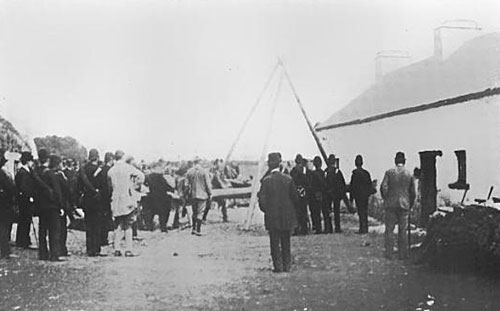
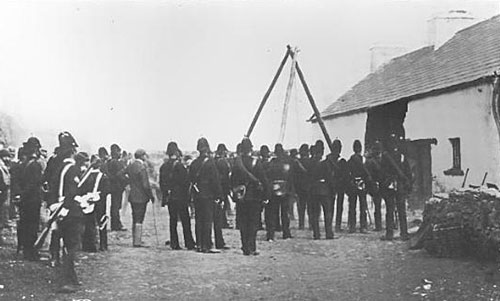
The following is an account of the Cleary eviction from Carradotia:
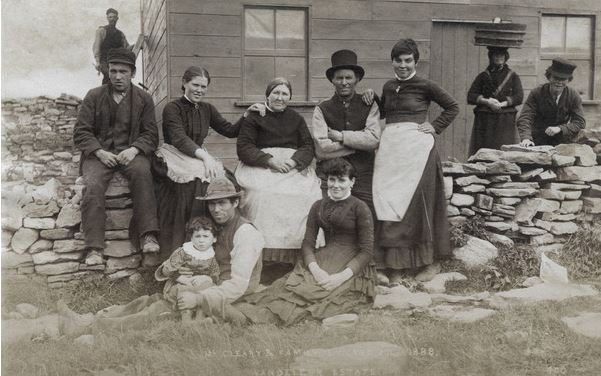
On the morning of Wednesday July 18 1888 left Kilrush and after a number of other evictions earlier in the day the procession 1.25 miles long moved to the house of Michael Cleary of Carradotia (near Moneypoint). Cleary had prepared to resist. A cordon of police was drawn up around the house, but at a distance. Within the cordon were allowed only officials, newspaper correspondents and some English and American visitors. Smoke was coming from the Chimney; a ladder was put up so that the chimney could be blocked with straw. Possession was demanded, but the only reply was a laugh from the girls inside. The police were ordered to fix bayonets and the bailiff’s set to work with crowbars and hatchets. An attack on the door only moved it slightly and hot water was thrown at the assailants. The tripod and battering ram were then brought up. Eventually a breach was made in the wall. The police seized two sisters and two brothers who had been in the house; after an impromptu court held in the field they were remanded but granted bail.
Special huts were provided by the Land League to shelter the evicted. In Killimer they were constructed opposite the Church where you now stand in the car park.
Evicted tenants had spent up to nine months from the autumn of 1888 in makeshift huts and temporary dwellings. They would have been inevitably exposed to cold, damp, bad ventilation and inadequate cooking facilities.
 Killimer Local History