Mary Ryan
Gone but not Forgotten
Mary Ryan’s reputation as one of the best midwives was acknowledged locally. Records show that she delivered at least 400 babies in their family home, many without the assistance of the doctor. She is remembered by many for walking the roads, bóreens and lanes of this parish and beyond with her little brown suitcase and a smile on her face, and she had a cheery word for all. The records testify that in the course of those visits she would have clocked up 14,400 miles in the course of her maternity care almost all done on foot! She was very professional and skilful in her role as district nurse and midwife. She visited new mothers daily for the duration of the required nine days and often longer, taking the temperatures of mother and child and checking all was well. Visiting the ill and homebound was also part of the day’s trekking. Sometimes she was collected by the father-to-be, in a horse and trap, when the baby was due to be delivered. People said that she had ‘lucky hands’ as records show she had an almost 100% success rate at delivering healthy babies. Mary was highly qualified – her study notes show the knowledge, dedication and interest she had in her profession.
She was born Mary Agnes Nugent in 1904 to Maurice and Bridget in Donail. She was the firstborn of this family. Her early studies began in Knockerra girls’ school; she kept a copybook from primary school as a souvenir, and later attended the Convent of Mercy, Kilrush. She was awarded a scholarship in P.O. communications which also involved learning Morse code. She worked in Newtonsandes Post Office (Moyvane) County Kerry. Her autograph book shows that she had a keen interest in the national politics of the time. She was a member of Cumann na mBan. Her husband-to-be Mick Ryan, Knockerra, was an active IRA member- his alias was ‘Rose’. In 1920 Mary moved to Horney near Kingston-upon-Hull, Yorkshire. After a year she returned home to bid her farewells as she intended emigrating to Australia. She had an uncle Richard Nugent in Adelaide and had planned to go there to train as a nurse. She made an effort to visit her future husband Mick Ryan who was interred in Mountjoy Prison but she was not allowed before leaving Ireland. She did get a ring from him as a memento, made from a florin in Mountjoy.
In 1921 she sailed from Liverpool and six weeks later docked in Freemantle and then on to Adelaide by boat. Her training lasted three to four years. Her nursing notes written during her years in Barmera Hospital, South Australia, and the Women’s Hospital, Melbourne, show a great love and pride in her chosen profession (her family still have these notes). When qualified she nursed in Adelaide and Melbourne and did private nursing in Ballerat and many more places. She recalled many of those memories to us in her later life as she had complete recall right into her senior years.
She returned to Knockerra to marry Mick Ryan, who was seventeen years her senior. Following the birth of their first child Gerard in 1935, and eager to continue her nursing in Ireland, she went to Dublin to retrain. To do this she had to overcome many obstacles back then as a mother. She brought baby Gerard with her and of course came through her exams with flying colours. Her expertise was often relied on in the treatment of pneumonia and during epidemics like diphtheria and polio in the 1940’s. She was kept busy doing home visitation, seeing to the needs of the sick, administering injections and treating wounds. Her daily treks throughout the parish as well as to Kilmurry McMahon, Kilrush and Cooraclare, are well documented by her. Keeping new born baby records was hard work, as back then she could not rely on the assistance of a computer. There was just her beautiful handwriting which leaves us a bird’s eye view of the important role she played in the health care of our community. She often spoke with fondness of the support she received. She had great insight into the family circle but discretion and confidentiality was assured as she was a true professional. Her duties took her on trips to Bessborough House to take care of the elderly Hassett sisters. She also laid out people when they died, up to the 1970’s. She was not only a nurse but would have also played the role of a counsellor while on her rounds.
She continued nursing and caring for people and finally retired in 1970. In her old age she was well respected and cared for by the young and old, who were very glad to visit her and enjoy listening to her stories or to her reciting poetry. She told friends how she loved to read essays and poetry – she did not have time to read a book. Her stories often included funny incidents like the time the man visited to get a diagnosis thinking that he was pregnant; her reply was, ‘Wait until I get the carving knife and find out’ and he made a very hasty exit!
She raised her seven children and, despite seeing them one by one emigrate, she continued to live in Knockerra with her husband Mick and later as a widow. Her diaries show her love of writing letters and receiving replies and learning about her grandchildren’s adventures. In addition, she longed for company. When a busy life stops for people it can become a lonely life, especially when one is on their own during sickness and old age, but the support of neighbours and friends eased all that for Mary.
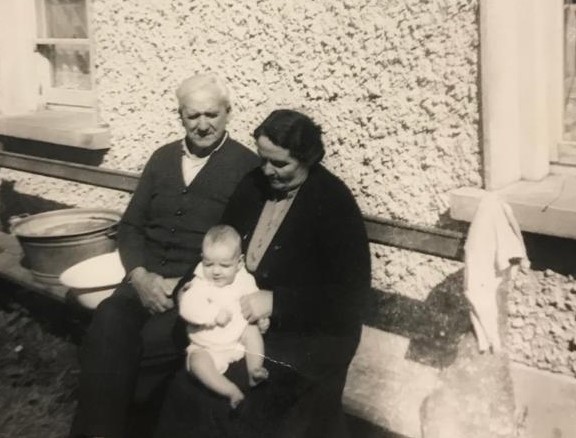
Bath time for baby Tony Dixon (USA) with his grandparents, Mick and Mary Ryan.
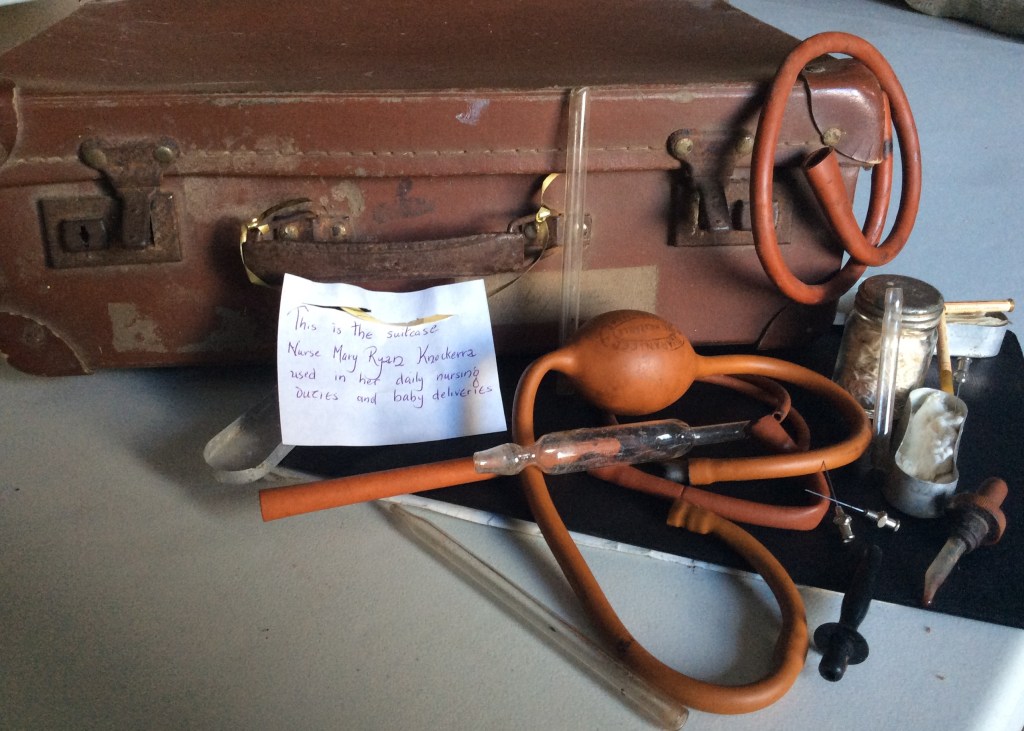
The contents of her brown suitcase, which the family donated to our museum, were:
- Ties – for the umbilical cord ties (sterilised threads from flour bags)
- Morphine tablets for pain
- Needles and syringes
- Mouth suction to remove mucus from the baby
- Gastric tube
- Enema tube
- Dropper to administer drops if required
- Ounzeler to weigh babies
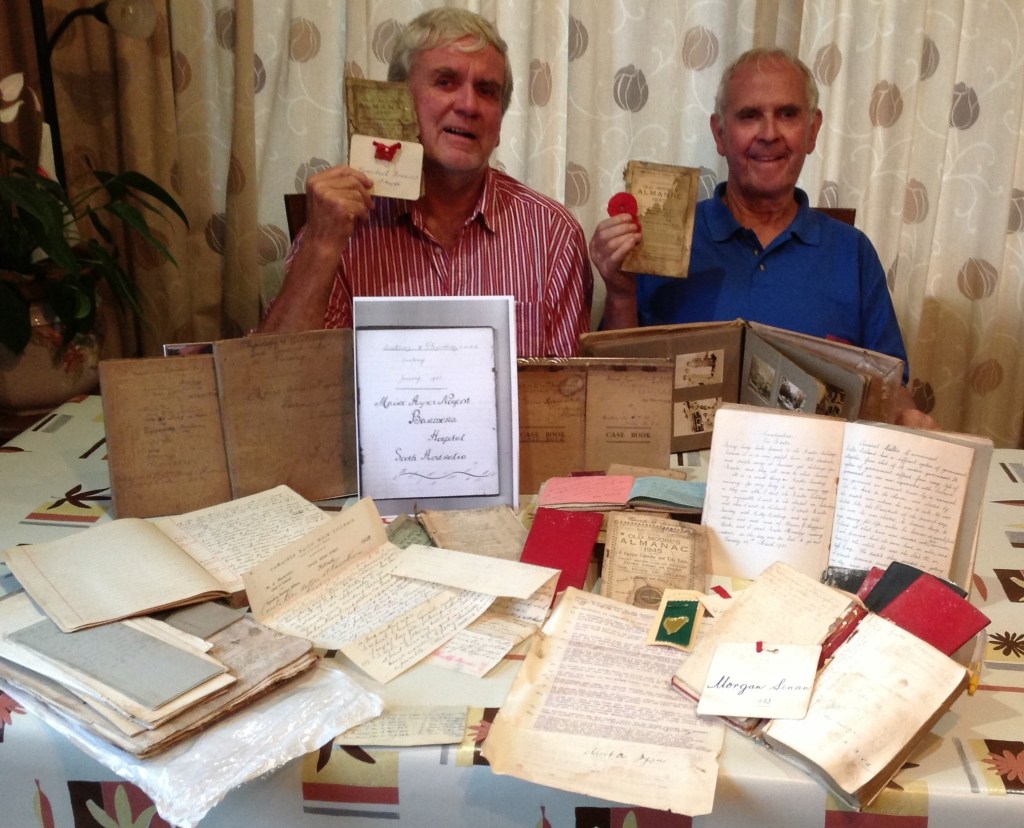
Above is a photo of her sons Benedict and Michael Ryan (Knockerra and England) presenting their mother’s memorabilia to the Local History Group. This included her medical suitcase with her medical devices, her college notes from her time in Australia, her photos from her time in Australia and her diaries relating to her time as a midwife.
She wrote the following account of some events and of the people that lived on Knockerra Hill
(Mick was her husband and all names mentioned would have been locals at the time)
I.R.A. snippets
Scanlans lived in a little house, over from Clunes now, Rod Iron’s House, where Mick spent the night alone on 29-6-1921, while his pals attended the wedding of Gretta and Jack Flanagan. It was their ‘hide out’ during troubled times.
Mick Kennedy and Pat English both from Tipperary, were together when they were removed from Limerick Prison to Mountjoy by Free Staters. They were the only I.R.A. prisoners not handcuffed, as none of the cuffs would fit their wrists. Mick met Mick Kennedy at a meeting in Ennis later on in 1925 when President De Valera was present. Mr Moore, a native of Kildysart was in Limerick Prison, a medical orderly assisting Officer Commander of the Free Staters. He had been disbanded with others from the British Army and sent to Ireland during the troubles.
Mick’s contemporaries in Mountjoy were Frank Barrett, brother of Joe Barrett, Martin Marrinan (Kilmacduane) a retired R.I.C. man, Billy (Liam) Pilkington I.R.A., Frank Gallagher and a Connell.
Connell, an I.R.A. prisoner, with Mick, in Limerick Prison, got sick and was sent to hospital where he got friendly with a nurse who was engaged to a Free State captain. He had a plan to escape the prison and told the nurse about it. She then told the captain of their escape tunnel from prison. They were discovered, within a few yards of completion.
Frank Gallagher went on to become a journalist. He wrote a page in the ‘Sunday Press’ for years. He wrote a series of short stories, writing under the pseudonym of David Hogan, called ‘Books from my shelves’.
Martin Marrinan was a first cousin of Marie Behan, Tonovoher and was stationed in a Barracks in Sligo and heard the military and the Tans arranging to go out Saturday night to capture Pilkington and Gallagher, so he took his prayer book and went to confession that Saturday night and told the priest to get word to them, by one who would come to confession, which he did. The house where they usually stayed was surrounded and searched that night but they had got away.
Local Families
Troys – Paric Troy’s wife was from the Reidy family from Ballinagun, Cree. Her father served in the Boer or Crimean War and had lost a leg. Her two sons, over 6 ft. tall, were teachers and went to Sligo or Mayo. Mick went with Paric to Paric’s father-in-law Mr Reidys funeral when he was a young boy about 15yrs. They had dinner at John Reidy’s (Tarmon Reidy’s) old home in Ballinagun, after the funeral, and returned home by pony and cart.
Doherty – Paddy Doherty lived near old Knockerra School and was a carpenter. We used his workshop for playing and getting in and out the windows at lunchtime. He was married to a Miss O’Connell from Carniskey. They had no family; Ellen Nolan bought their place, now Powers have it.
Nolan – Nolan’s were here in James’s house, where we live now opposite R.H.O. houses Knockerra. Peggie Giltenane was their mother. The sons were Paraic, went to U.S.A. and died there, Sean (22-6-1876), killed in France during the war, Martie (1879) died young and Thomas (1884). Paraic, born in 1875, was the eldest joined the British Army and served in India. Afterwards he went to the U.S.A. My husband Mick called to their house in New York. Mick took hand-made socks to Paraic Nolan in New York from his mother Peggie.
Eustace – Mrs Eustace, Knockerra, lived in the eastern portion of the old school house. Mrs Lardiner and Johnny lived in the west portion. She was Nance Mack before she married. She chased us many a time from her tree, where we used to swing during playtime and hang off the branches. Her sister was married to Hanrahan’s father (his second wife) as family and they lived in a little house off the main road in Patsy Miniter’s quarry (the avenue up to Miniter’s and Driscoll’s), Granatooha. One evening when the husband returned from Kilrush, he found her hanged. He had a war pension.
Hastings – Michael Hastings and his family lived in the west end of Knockerra old school, where Lardiner’s lived after him. He was an uncle of Molly Hastings in the mail road also Mrs McGrath. Her daughter Brigie went to school with me at Knockerra and went to the U.S.A. Mrs Griffin R.I.P. used write letters for Molly to her daughter Brigie McGrath in America. Mrs Hastings was Noelly Lynch before her marriage. She was very frail and not well, supposed to die when fairly young. Micheal the father died at home and the family went to the U.S.A. Tom Hastings was brother of Micheal and father of Noelly (Mrs McGrath), her father was nick-named Pollack and they lived up by the mail road in a little house in Griffin’s field. Noelly Hastings used to work around at the local farmers houses. When the telegram came to Noelly that her husband was dead in Ennis Hospital she said ‘wasn’t it nice of him to write and he so sick’.
Mangan – Tom Mangan was married to Biddy Griffin; her sister Margaret was Mick’s godmother, B. July 1887. Biddy was 1st cousin of Paric Troy, his aunt a Troy woman was married to Griffin up in Monmore. Tom Mangan’s wife died and left a young family and Kate Troy (nee Brennan), Paric Troy’s mother went and reared the family. They lived in a small house at that time above the road in Jack Larry Miniter’s field, just opposite Denis Maloney’s avenue (Carhuefree). Later they got a cottage on the road further west where Mary Jane Browne now lives. Johnny Lardner’s missus and family then lived in Tom Mangan’s little old house in Miniter’s field before they came to Knockerra old school house, after Michael Hastings and family left for America. Nell Lardiner was born back there in the little house in Miniter’s field.
Jack Flanagan – Big Jack as he was known, a tall man about 6’ 3’’, grandfather of Flanagan lived where Harvey’s are now (Derreen, Tullycrine). He used to walk to Knockerra from there, a few times every week to visit Mick’s father and have a chat. He wore knee breeches, with several yellow buttons on the legs. When his visit ended he walked over the Knockerra Road to his home, a round tour.
Mrs Kate Hayes – Kate Hayes came from near Kilkee or thereabouts and married Brew, a father of the man from whom we bought Mangan’s turf bank. Brew was a widower and she a widow. Brew’s family grew up, their father died and they sent Kate off the place. She then came to Knocknahuan and married Tom Sexton, who lived in a little house in our bog garden; it belonged to Browne’s (Paddy Cod) at that time. Sexton had been a widower also from near Kilkee and had given up his large farm. He had come to Knockerra and married a Custy woman who lived in this little fore mentioned house and she died and Sexton died after some time and Kate married for a fourth time to Jack Eustace who was blind. When they both grew too old to care for themselves, they were removed to hospital then known as the workhouse where they ended their days and they were the last inhabitants of the little house in the bog.
Jamsie O’Brien and Pat Carmody – Two old men who lived in two little houses on the Mail Road, one in Kelly’s house and the other in a little house further to the east (now demolished) and were pals in the war in India. They used to give hair-raising accounts of the brutality of the English soldiers to the natives. When the natives were at their prayers in one big crowd together, the British soldiers fired volleys into them killing some and causing the others to flee in terror.
Downes – Bill Downes (brother of Jim Downes) with Jack Reidy (Danny Reidy’s brother), Tarmon, built Mr Randal Joacham Pius Behan’s house. Bill Downes was married to a woman from Labasheeda, and had one daughter who was lame and was a dressmaker. Miss Downes, her Aunt was also a dressmaker who lived in Kilrush and used come to the country frequently for weekends. Bill Downes’s wife died and he married and lived in Kerry afterwards.
Pearce Mahony – Pearce’s lived where Joe and Paddy Mahony now live. They all had T.B. Marky Mahony’s father came down from near Keating’s Tullagower and married in there, to a Pearce girl. She died, and left son Jack Mahony who lived and died a bachelor in Liverpool. The father then married Tom Ned Browne’s sister from Burrane and Markie was their son, hence Paric Ned the ‘Bowler’ visiting Mahony’s.
Paud Mahony R.I.P. disappeared for three days with his horse and dog and every one of his neighbours and friends were looking for him. He returned but gave us no account of his whereabouts and nobody ever found out where he spent the three days.
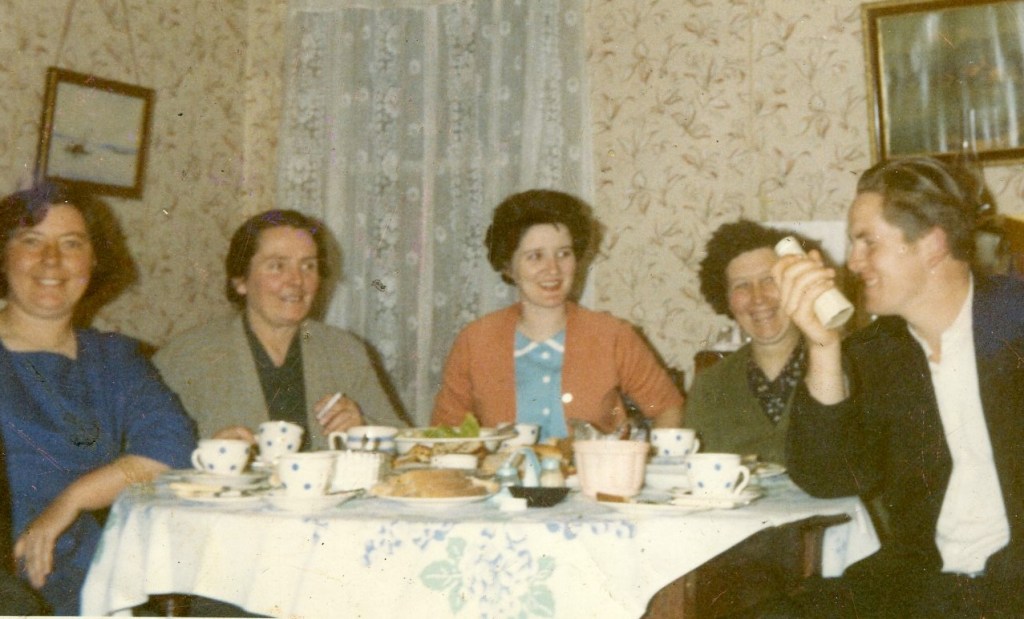
Nancy Casey, Mary Ryan, Lil Ryan, Bridie Madigan and Benedict Ryan (Marys son).
Home Birth Deliveries
400 babies = 3,600 visits = 14,400 miles.
Townlands visited:
Coolminga
Breaffa
Cappa
Molougha
Gowerhass
Caherufree
Carniskey
Tullycrine
Tarmon
Derrylough
Burrane
Tonovoher
Lisnadeen
Brisla
Knocknahuan
Knockerra
Tullabrack
Ballycurrane
Kilcarrol
Poulnadaree
Granatooha
Trellig
Moyadda
Donail
Blain
Donogrogue
Tullagower
Carradotia
Thomastown
Doctors on duty:
Dr Daly
Dr Walsh
Dr McAuliffe
Dr Lillis
Dr Coughlan
 Killimer Local History