John H Elliotts Diary
Travellers who liked to make journeys around Ireland, keeping letters or journal entries of their days, are not unusual. In fact on this link you can explore many collected by UCC – https://celt.ucc.ie/travel_geog_hist.html
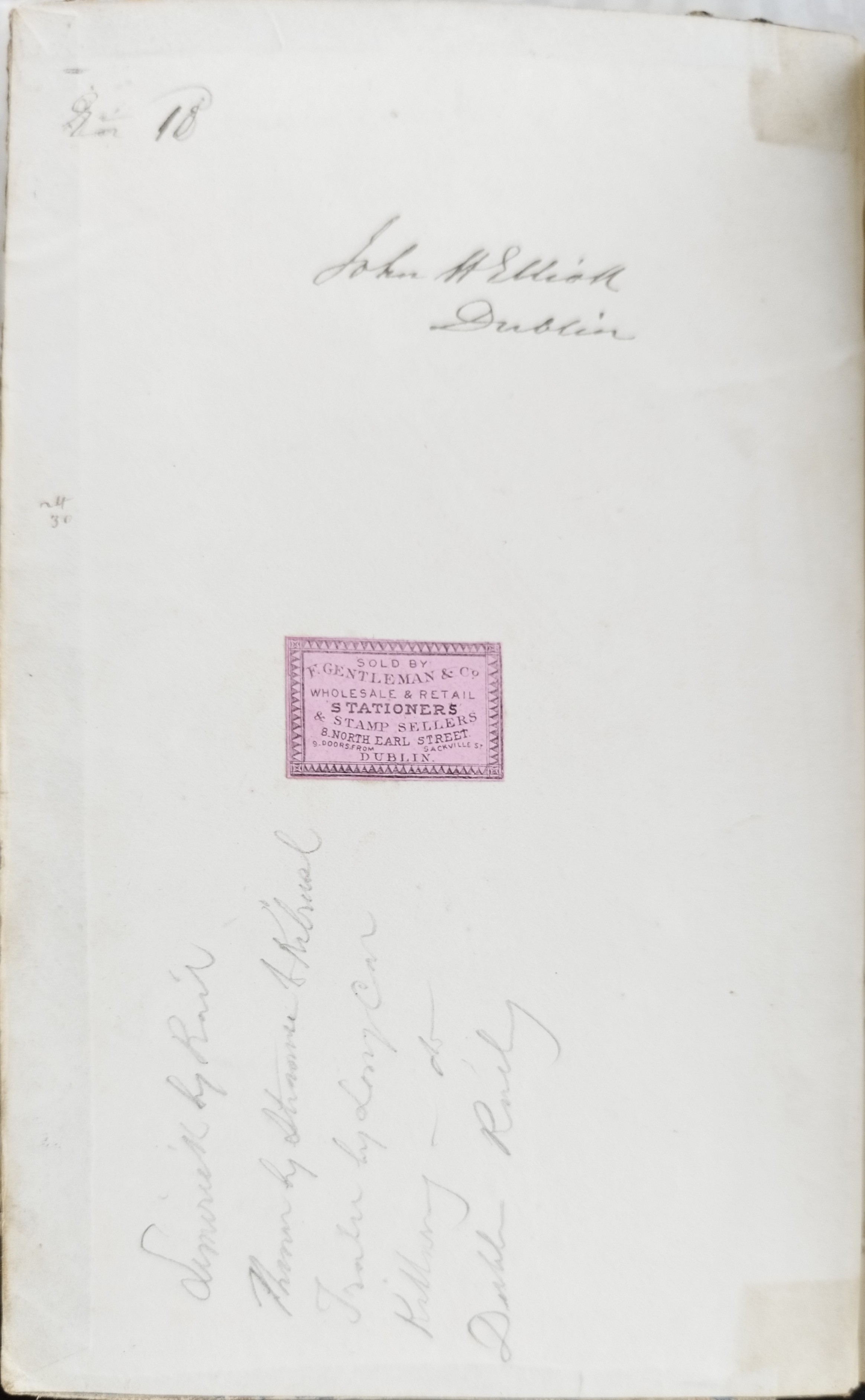
In our first publication we used quite a few of them to give you an insight into our parish back in the 1800’s. What we didn’t expect to stumble upon however, was a handwritten diary from 1845 of one of these travellers. We were contacted by someone who while emptying out their attic came across this diary, and what a gem of a find it is! This diary was written by someone called John H Elliott and it follows his tour through Ireland and beyond.
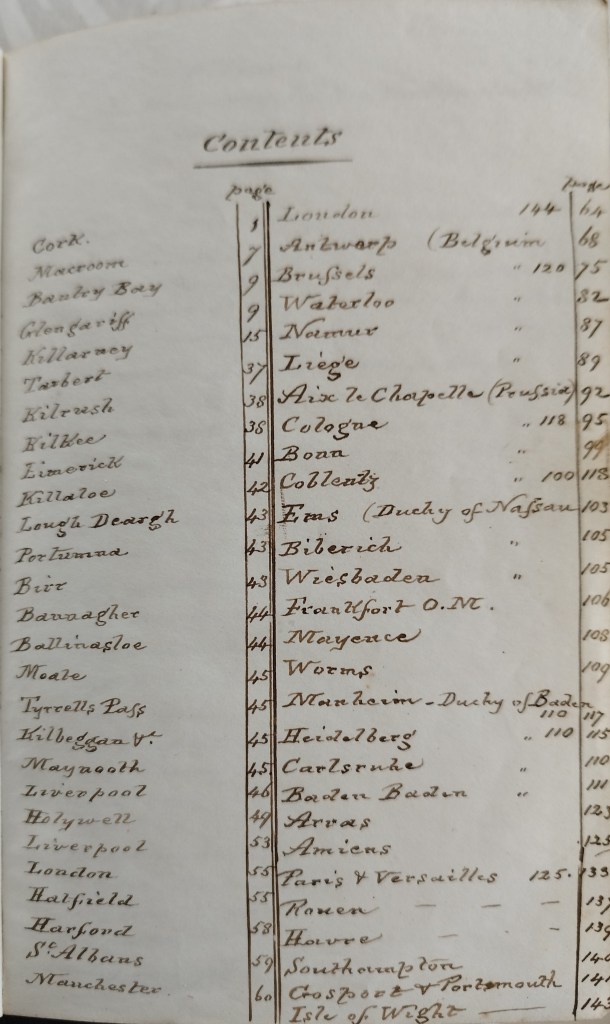
What an amount of travelling to do at that time. We have kindly been given the permission to share the local entries with you before the diary is given to a museum. It just shows the treasures that can be hidden, in older houses and attics in particular, and to be careful when throwing things out. We hope you enjoy it as much as we do, we found the narrator quite amusing with a dry wit. He also must have been highly educated as he slips in quotes and lines of poetry as he goes along. It also must be remembered this diary would have been written just at the beginning of the famine, just as the first crop of potatoes failed.
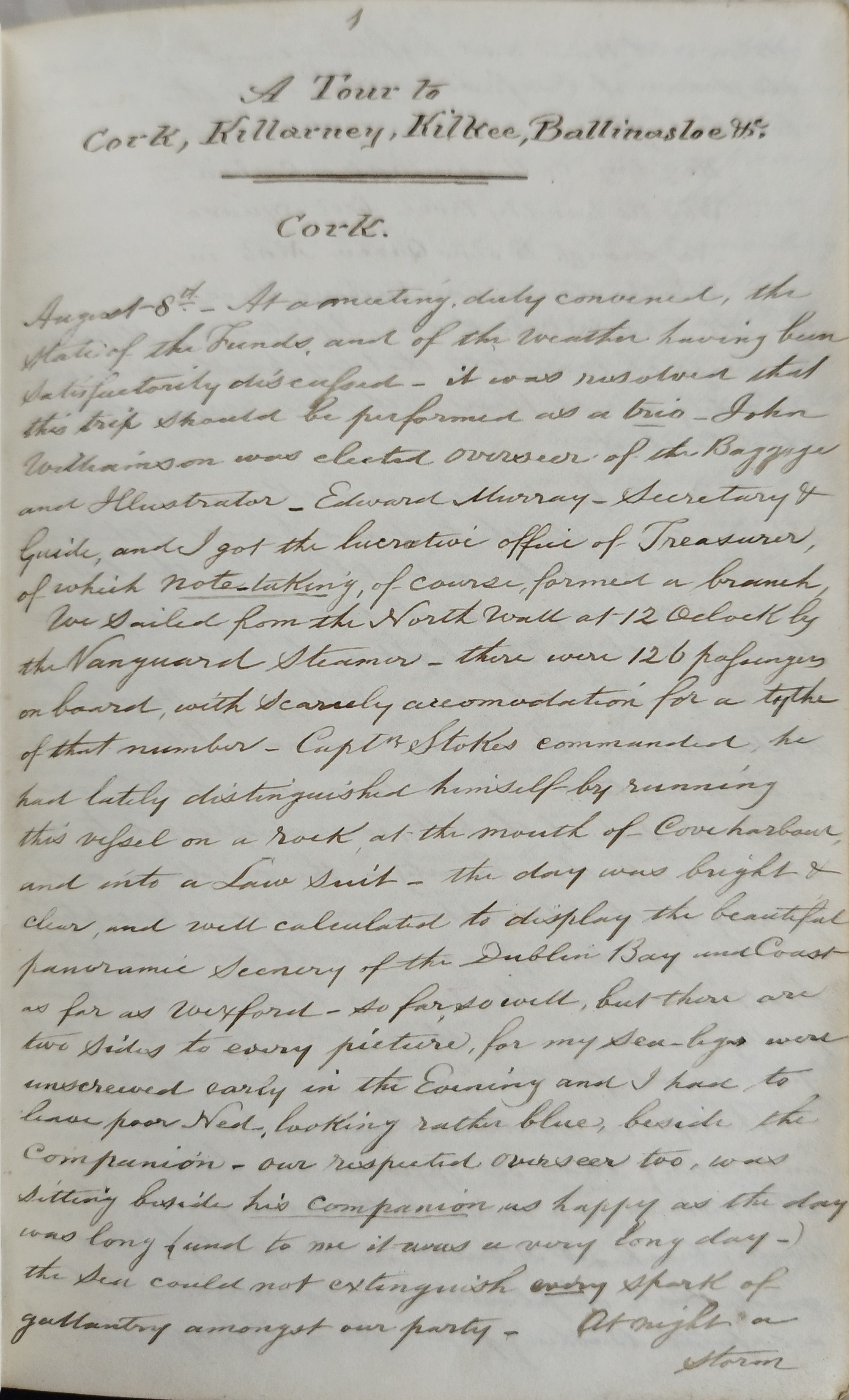
A Tour to Cork, Killarney, Kilkee and Ballinasloe
8th August 1845
At a meeting, duly convened, the state of the funds and of the weather having been satisfactorily discussed – it was resolved that this trip should be performed as a trio – John Williamson was elected overseer of the baggage and illustrator. Edward Murray as secretary and guide and I got the lucrative office of treasurer, of which note taking of course formed a branch. We sailed from the North Wall in Dublin at 12 o’clock by the Vanguard Steamer – there were 126 passengers on board, with scarcely accommodation for a total of that number – Captain Stokes commanded, he had lately distinguished himself by running this vessel on a rock at the mouth of Cobh Harbour and into a law suite. The day was bright and clear and well calculated to display the beautiful panoramic scenery – so far so well but there are two sides to every picture, for my sea legs were unscrewed early in the evening and I had to leave poor Ned, looking rather blue beside the companion as happy as the day was long and to me it was a very long day.
The sea could not extinguish every spark of gallantry amongst our party. At night a storm with rain and lightening came on, and the scene of confusion that was then enacted below, baffled even Byron’s description:
“ Hey day- call you that a cabin –
Why tis literally 3 feet square
Not enough to stow Queen Mab in
Who the deuce can harbour there”
(Byron’s Mediterranean Poems, 1809-11, Byron’s first voyage to Greece and Turkey began when he left Falmouth in Cornwall on July 2nd 1809, and ended with his return at Sheerness in Kent on July 14th 1811)
At half past three o’clock a.m. I picked my steps over the mass of mortality that lay packed indiscriminately, over the floor, with more resignation than comfort – the first breeze on deck was most exhilarating after the heat and havoc of the night. We were obliged to wait at Cobh for the tide.
(We now skip from his description of Cobh, Macroom, Bantry Bay, Glengariff and Killarney to Tarbert.)
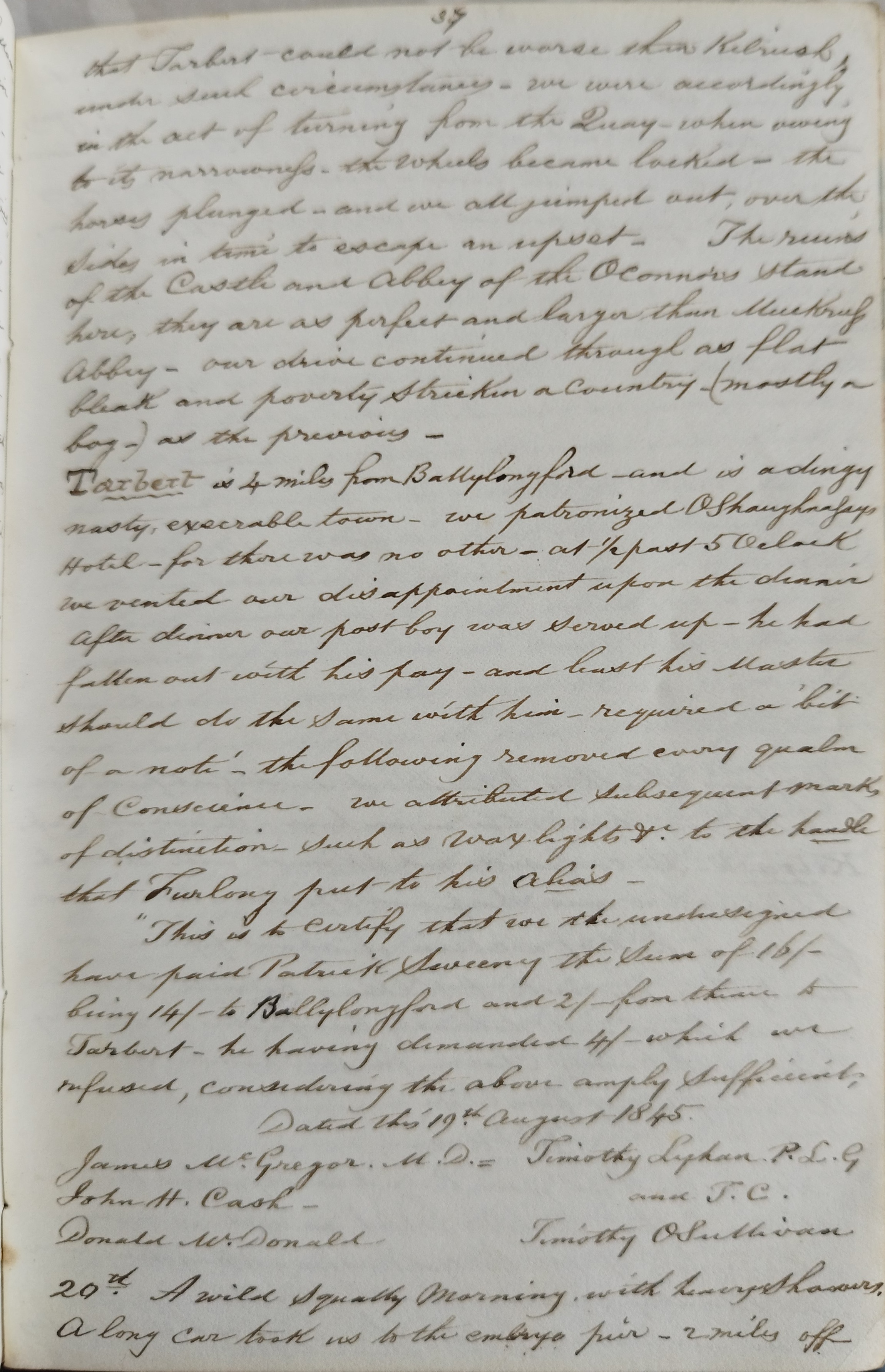
Tarbert is 4 miles from Ballylongford and is a dingy, nasty execrable town – we patronised O’Shaughnessy’s Hotel – for there was no other at half past five o’clock, we vented our disappointment upon the dinner. After dinner our post boy was served up, he had fallen out with his pay and the least his master should do the same with him – required a bit of note. The following removed every qualm of conscience. We attributed subsequent mark of distinction such as
way lights and to the handle that Furlong put to his alias.
“This is to certify that we the under signed have paid Patrick Sweeney the sum of 16/- being 14/- to Ballylongford, and 2/- from there to Tarbert. He having demanded 4/- which we refused, considering the above amply sufficient”
James McGregor M.D.
Timothy Lydon P.L.G. and T.C.
John H. Cash
Donald McDonald
Timothy O ‘Sullivan.
20th August 1845
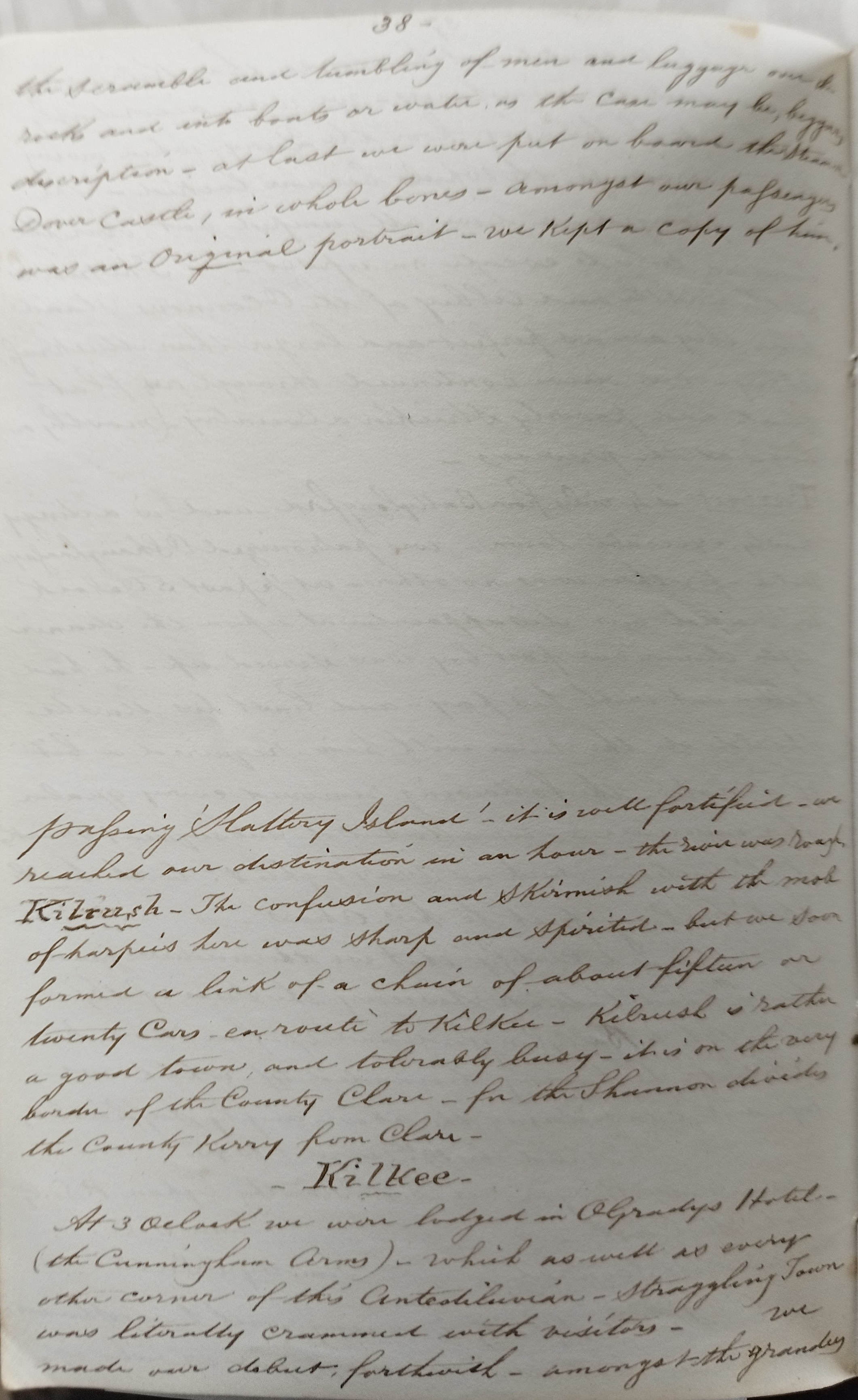
A wild squally morning with heavy showers, a long car took us to the embargo pier two miles off. The scramble and tumbling of men and luggage over the rocks and into the boats or water as the case may be, beggars description – at last we were put on board the steamer, Dover Castle, in whole bones, among our possessions was an original portrait – we kept a copy of him. Passing Scattery Island – it is well fortified, we reached our destination in an hour, the river was rough.
Kilrush
The confusion and skirmish with the mob of harpies here was sharp and spirited, but we soon formed a link of a chain of about fifteen or twenty cars en route to Kilkee. Kilrush is rather a good town and totally busy. It is on the very border of County Clare, for the Shannon divides the County Kerry from Clare.
Kilkee
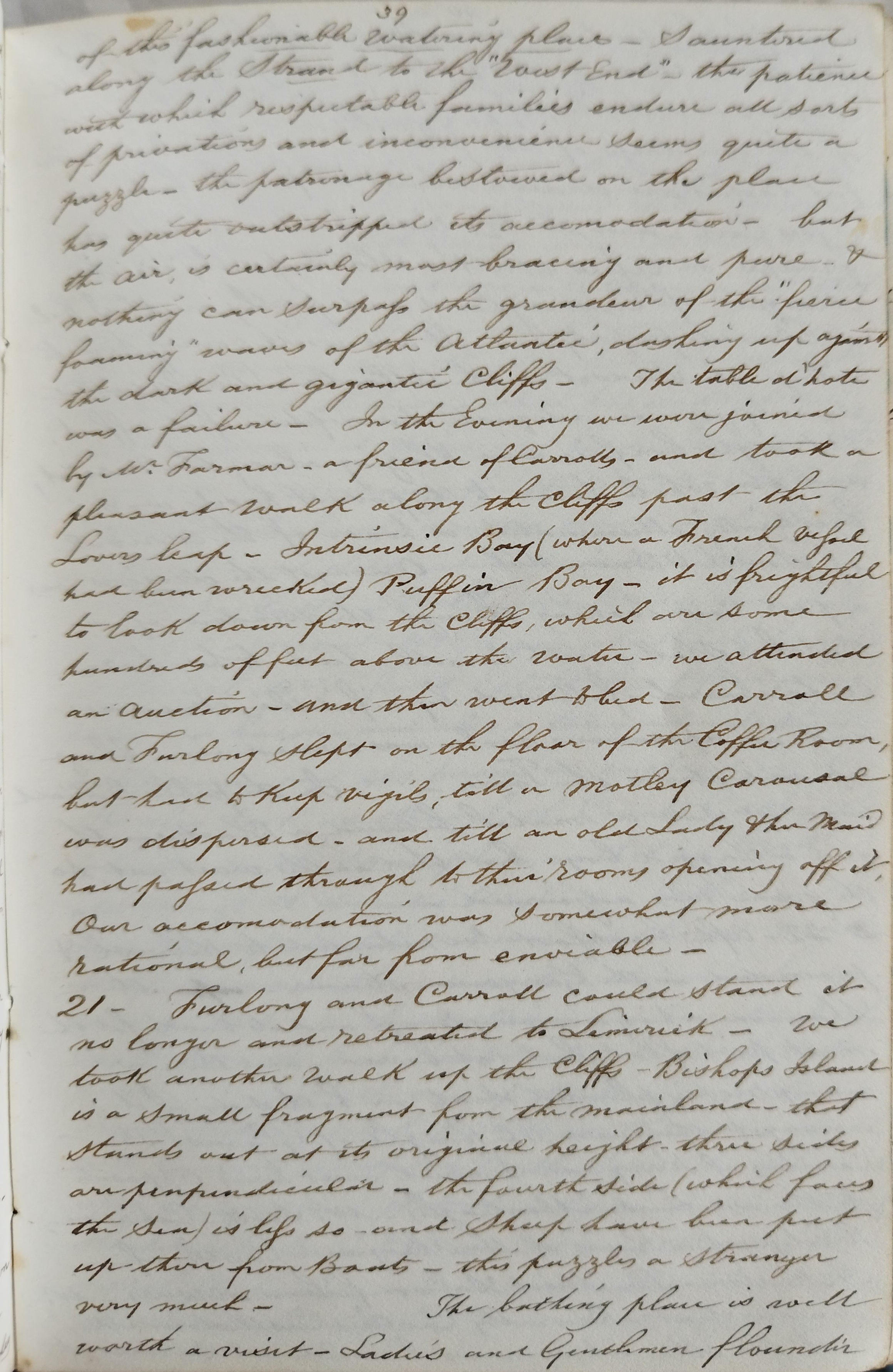
At 3 o’clock, we were lodged in O’Grady’s Hotel- (at Cunningham Arms) which as well as every other corner of this Antediluvian – struggling town was literally crammed with visitors, we made our debut, forthwith, amongst the grandeur of this fashionable watering place, sauntered along the strand to the ‘East End’. The patience with which respectable families endure all sorts of privations and inconveniences seems quite a puzzle. The patronage bestowed upon this place has quite outstripped its accommodation but the air is certainly most bracing and pure and nothing can surpass the grandeur of the ‘fierce foaming waves’ of the Atlantic dashing up against the dark and gigantic cliffs. The table at the hotel was a failure. In the evening we were joined by W. Farmer, a friend of Carroll’s, and took a pleasant walk along the cliffs past the ‘Lovers Leap’-Intrinsic Bay (where a French vessel had been wrecked) Puffin Bay – it is frightful to look down from the cliffs, which are some hundreds of feet above the water. We attended an auction and then went to bed. Carroll and Furlong slept on the floor of the coffee room, but had to keep vigil until a motley carousal was dispersed and till an old lady and her maid had passed through to this room opening off it. Our accommodation was somewhat more rational but far from enviable.
21st August 1845
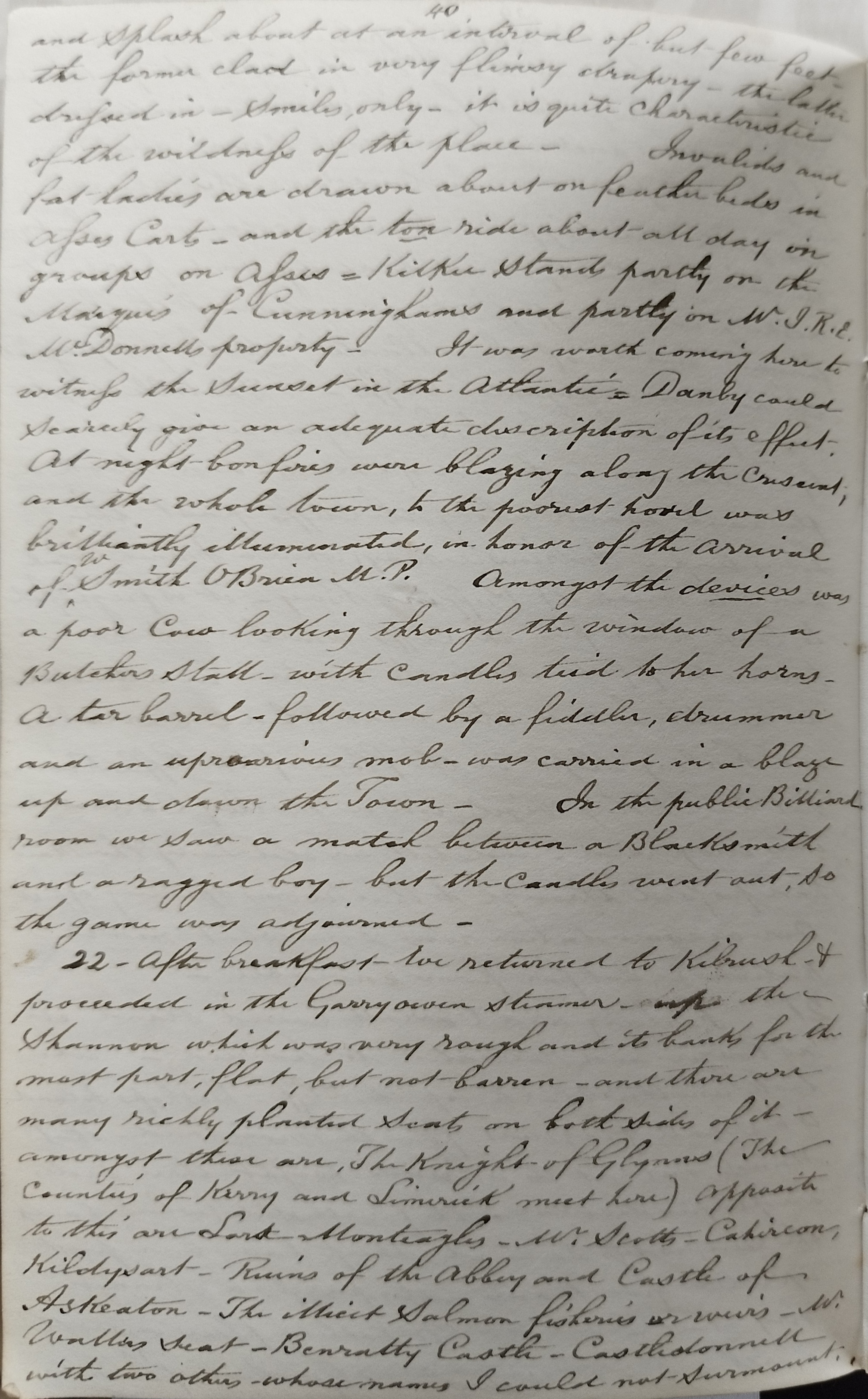
Furlong and Carroll could stand it no longer and retreated to Limerick. We took another walk up the cliffs – Bishops Island is a small fragment from the mainland that stands out at its original height. Three sides are perpendicular and the fourth side (which faces the sea) is less so. And sheep have been put up there from boats – this puzzles a stranger very much. The bathing place is well worth a visit, ladies and gentlemen flounder and splash about at an interval of but a few feet, the former clad in very flimsy drapery, the latter dressed in smiles only. It is quite characteristic of the wildness of the place. Invalids and fat ladies are drawn about on feather beds in asses carts – and the ton ride about all day in groups on asses. Kilkee stands partly on the Marquis of Cunningham’s and partly on W.I.R.E. McDonalds property. It was worth coming here to witness the sunset in the Atlantic. Darby could scarcely give an adequate description of its effect. At night bonfires were blazing along the crescent and the whole town to the poorest hovel was brilliantly illuminated in honour of the arrival of W. Smith O’Brien M.P. Amongst the devices was a poor cow looking through the window of a butchers stall – with candles tied to her horns. A tar barrel followed by a fiddler, drummer and an uproarious mob – was carried in a blaze up and down the town. In the public Billiard Room we saw a match between a Blacksmith and a ragged boy, but the candles went out so the game was adjourned.
22nd August 1845
After breakfast we were returned to Kilrush and proceeded in the Garryowen Steamer up the Shannon which was very rough and its banks for the most part flat but not barren and there are many richly planted Scots on both sides of it – amongst these are the Knight of Glin (the counties of Kerry and Limerick meet here), opposite to this are Lord Monteagles – W. Scott’s – Caheracon, Kiladysart, ruins of the Abbey and Castle of Askeaton. The illicit salmon fisheries and weirs. W. Williams seat, Bunratty castle, Castleconnell with two others whose names I could not surmount. Sir Joseph Barrington and Lord Landsdowners properties were also on the bank. At seven o’clock we landed in Limerick.


 Killimer Local History